Your Cart is Empty

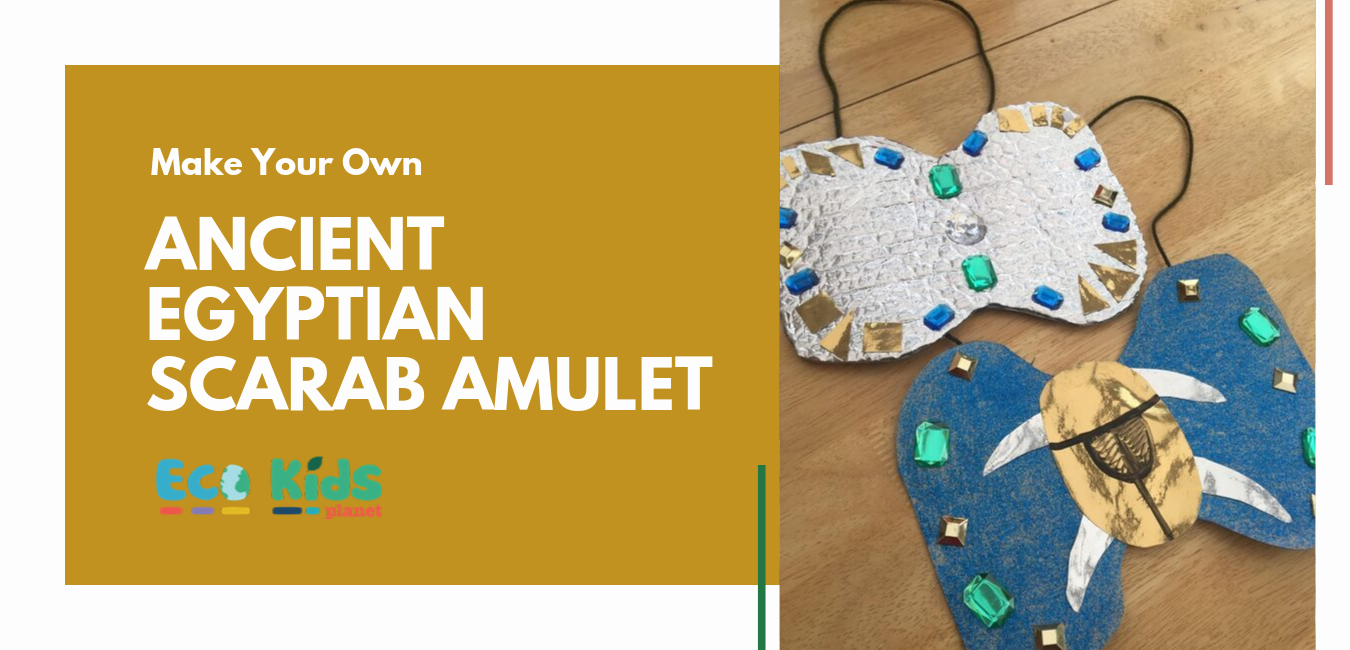
The Egyptian scarab was one of the most sacred amulets in Ancient Egypt. The scarab represented new creation and eternal life and was thought to give protection against evil. These amulets were carved out of stone or moulded in glass or Egyptian ceramic. They were everywhere: worn on necklaces, carved in buildings and used in seals.
Step 1: Draw the shape of your amulet on to the cardboard. Cut this out.
 Step 2: Paint your template using your favourite colour. This may take a couple of layers. Leave to dry.
 Step 3: Use your leftover cardboard to make a leg template, this will ensure all of the beetle’s legs are the same. Draw four legs on to the silver paper, making sure you have two facing left and two facing right. Cut these out.
 Step 4: Draw and cut the oval body of the scarab beetle from your gold paper. Use your marker pen to add the beetle’s markings.
 Step 5: Glue these to the centre of your amulet. They may need something heavy to rest on top for 10 minutes to help glue them into place.
 Step 6: Cut out different shapes from your silver and gold paper. Stick these, alongside your gemstones, on to the amulet for decoration. What patterns will you create? Make sure you leave this to dry completely.
 Step 7: Cut your string to approximately 30cm. Secure this to the back of your amulet with sticky tape. Ta-da! You’re all done! Don’t you look fantastic wearing your new amulet?
Comments will be approved before showing up.

This competition asked you to design a secret egg hidden somewhere in nature, and your entries went far beyond the obvious nests and burrows. Eggs arrived disguised as pine cones, floating on leaf boats, perched on volcano ledges, tucked into cloud cover and even masquerading as chocolate Easter eggs to fool foxes. Thank you to every reader who took up the challenge and thought like a parent bird, fish, reptile or imaginary creature trying to keep their precious egg safe.

We were swept away by the response to this competition. Letters arrived from rivers across the world – the Thames, the Mississippi and many more unnamed waterways – each one brimming with personality, passion and a genuine love of the natural world. You gave your rivers voices that were worried, hop...

Somewhere beneath a grassy field right now, a tiny insect is building an underground loudspeaker. Male mole crickets engineer horn-shaped burrows that amplify their calls hundreds of metres into the night air – and your child can recreate the same science at home using nothing but cardboard and a phone. This hands-on experiment explores sound, shape and natural engineering in a way that is genuinely surprising. No screens, no special equipment, just a brilliant idea borrowed from nature.