
Your Cart is Empty

The blue whale is the largest creature to have lived on Earth – ever! It’s even bigger than any of the dinosaurs were. This massive marine mammal quietly cruises across the world’s oceans in search of food and to raise a family. It’s hard to believe that we very nearly lost this awesome animal altogether.
Everything about the blue whale is BIG!
• It measures up to 30 metres in length – longer than three buses!
• It can weigh over 150 tons – that’s as heavy as 30 elephants!
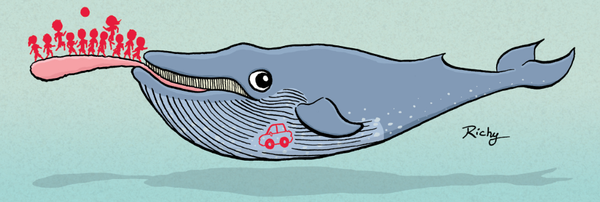
• A blue whale’s heart is the size of a small car!
• Its tongue is so big a whole football team could stand on it!
• Its calls are louder than a jet plane. They can be heard by other blue whales over 1,000km away!
• A blue whale lives for 80 to 90 years!
The blue whale is the biggest animal in the ocean, but it eats one of the smallest. It feeds on krill – tiny, shrimp-like crustaceans that swim about in the water. A blue whale needs to gulp down about 40 million krill every day!
 Blue whales migrate as the seasons' change. Many spend the summer at their favourite feeding grounds, near the Arctic and Antarctic, filling up on krill. Then they move to warmer, tropical waters for the winter, to breed and give birth. Travelling between the two areas takes a blue whale up to four months, and it can cover thousands of kilometres on the way. That’s one amazing migration!
There are estimated to be between 10,000 and 25,000 blue whales in the world. This might sound like a lot, but just over 100 years ago, there would have been many, many more. During the first part of the 20th century, blue whales were often hunted by people on whaling ships. Hundreds of thousands of them were caught and killed for their meat and oil. Because of this, the blue whale very nearly became extinct. Hunting blue whales was eventually banned in 1966. Since then, the number of whales in our oceans has slowly increased. But the blue whale is still classed as an ENDANGERED species.
The blue whale isn’t hunted any more, but it is still threatened by several things:
1. Climate change could mean that our oceans get warmer. This might affect the availability of krill.
2. Noise from ships and drilling for oil and gas can confuse blue whales and make it harder for them to communicate with one another.
3. Ships can kill or injure whales if they hit them. Whale-watching boats can disturb their normal behaviour.
4. Fishing nets can trap and drown whales.
5. Ocean pollution can poison whales.
6. Whaling is banned at the moment, but if the number of blue whales keeps increasing, people might want to start hunting them again.

What would the world be like without the blue whale? If we want it to carry on cruising our seas for centuries to come, we need to learn from the past and look after this gentle giant of the ocean.

It is sad the blue whale might get extinct from pollution and climate change. What colour is their ear wax?
Comments will be approved before showing up.

Somewhere beneath a grassy field right now, a tiny insect is building an underground loudspeaker. Male mole crickets engineer horn-shaped burrows that amplify their calls hundreds of metres into the night air – and your child can recreate the same science at home using nothing but cardboard and a phone. This hands-on experiment explores sound, shape and natural engineering in a way that is genuinely surprising. No screens, no special equipment, just a brilliant idea borrowed from nature.

Our Risky Moment competition invited young explorers to capture a risky moment in the wild – a split second when animals must make bold choices to survive. From daring leaps across rocky cliffs to dangerous river crossings, we received many hair-raising entries showing just how adventurous life in nature can be.

A huge thank you to everyone who entered our Winter Explorer competition. You proved that winter is not ‘empty’ at all – it’s full of clues, if you know how to look.


Sien
July 06, 2022
So someone can crawl through a bleu whales heart?